


Missing corners or missing edges are calculated by the sum of the three sides of the defect (see the figure below).
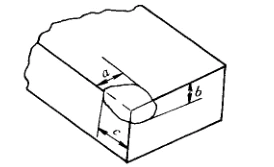
Broken corners
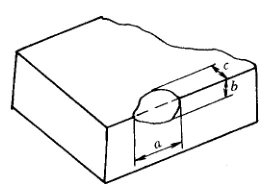
Broken ribs
Ⅳ.Crack detection
1. To check the crack, use a steel ruler with a scale of 0.5mm and a steel wire with a diameter equal to the width of the crack (for example, 0.1, 0.25, 0.5, 1.0mm).
2. Check the crack, the steel wire naturally inserted into the widest part of the crack, but shall not be inserted into the naked eye visible particles off. As long as the 0.25mm steel wire can not be inserted into the crack, its width with <0.25mm said. As long as the 0.25mm wire can be inserted into the 0.5mm wire can not be inserted into the crack, its width with 0.26 ~ 0.5mm. And so on.
3. The crack is not straight, can be measured by the number of line segments. The sum of the length of each line segment is the total length of the crack. The crack with interruption in the middle and the interruption distance is greater than 5mm (including the crack without restriction), that is, 1 crack. The length of the combined calculation, except for the cross and parallel direction of the crack.
4. Across the prism of the crack, except for special provisions, are calculated according to the continuous length. 1 crack across the working surface and non-working surface at the same time, are assessed by the working surface. In the corner across the two prongs of the crack, as long as it is not more than the range of values specified in the missing corner, not calculated by across the two prongs. As long as the crack is not limited in the standard provisions, all are not subject to the restrictions across the prongs and are not checked.
V. Inspection of distortion
1.Twist inspection with a stopper made of metal sheet. The width of the ruler is 10mm, and the thickness is 0.1mm larger than the allowable limit specified in the standard (for example: 1.6, 2.1, 2.6, 3.1, 3.6mm, etc.).
2.When inspecting the distortion, put the inspected surface of the product on the plate (the area of the plate should be larger than the inspected surface of the product) and keep the natural smoothness. Then insert the stopper smoothly along the surface of the plate into the maximum gap between the plate and the product, and the depth of inserting the stopper does not exceed 10mm is qualified.
3.Check the indentation by twisting method.
VI. Inspection of end plane tilt
1.For the inspection of end plane tilt, use a right angle steel ruler with side length 220mmx220mm and a metal stopper with width 5mm and thickness 0.1mm larger than the allowable limit specified in the standard (for example, when checking the end plane tilt of 2.0mm, use a stopper with thickness 2.1mm).
2.Check one side of the right-angle steel ruler and the longitudinal surface of the product in close contact, while making the other side of the right-angle steel ruler close to the end, and then insert the stopper along the gap formed between the right-angle steel ruler and the end smoothly, in order to stipulate that the stopper cannot be inserted as qualified。
VII. Inspection of slag corrosion
1.As long Because of other impurities and the surface of the product chemical changes, so that the product surface erosion and melt discoloration, collectively referred to as slag corrosion.
2.After processing and smoothing, no significant pitting and erosion of the product, not to slag corrosion.
VIII. Inspection of brick billets
1. As long as the same raw materials, the same process of production of products, after firing the appearance of color and normal production of products are significantly different, size expansion and contraction is not enough, cross-sectional open particles significantly and constantly open, then the firing of products should be checked.
2. Brick billet determination to physical properties identification shall prevail.
3. Brick billets should be handled as substandard products.
IX. Inspection of the section
1. As long as the products due to the molding of the layered and cross-sectional gaps in the laminar tissue, that is, the section of the layer crack. Section of the product with a hammer and steel chisel in the direction of the length perpendicular to the product forming pressure surface to take. The inspection of section lamination crack is carried out according to this section IV.
2. Since the product due to firing and significant local discoloration, such as black and red, etc., that is, black or red heart. Have a black or red heart of the product is judged to be substandard (Al2O3 ≥ 75% of the high alumina brick due to high temperature caused by the black heart except).
X. Inspection of working surface and non-working surface
1. As long as the drawings indicate the work surface on the product, all according to the standard work surface inspection. Not specified in the working surface of all non-working surface inspection.
2. The corners connected with the working surface, all according to the provisions of the working surface inspection.


